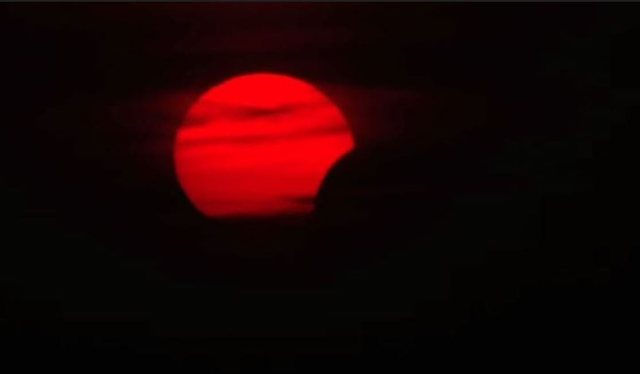
GET READY! What you need to know about the total solar eclipse happening in August, the first visible one since 2006
On August 12, daytime will briefly turn into night in parts of northern Spain when the Moon completely covers the Sun during a rare total solar eclipse.
Here is what you need to know about this eclipse, the first visible from mainland Europe since 2006.
Eclipses occur when the Moon passes directly between the Sun and Earth, casting a narrow shadow across our planet.
This creates an unusual twilight, during which temperatures drop, shadows appear at strange angles, and some animals go to sleep.
These unusual phenomena led ancient cultures to view eclipses as signs of the apocalypse or messages from the gods.
However, according to NASA, they are simply the result of a “cosmic coincidence.”
“Although the Sun is about 400 times larger than the Moon, it is also about 400 times farther away,” the U.S. space agency says.
This means that, for people in the right location, the Moon completely covers the Sun, revealing its outer atmosphere, known as the corona.
Where will it be visible?
On August 12, a remote region of northern Russia will be the first place to witness the total eclipse.
The “path of totality,” as it is known, will then pass over Greenland, Iceland, Spain, and the northeastern tip of Portugal.
In Spain, it will stretch approximately from the northern city of Oviedo to the island of Mallorca.
How long will it last?
For observers in Spain, the total eclipse will last less than two minutes, shortly before sunset.
For example, the northern city of Burgos will be plunged into darkness for exactly 1 minute and 48 seconds.
In some parts of Russia and Greenland, it will last slightly longer, but still less than two and a half minutes.
Meanwhile, partial eclipses, which occur when the Moon begins and completes its passage in front of the Sun, will last around 1 hour and 45 minutes.
Partial eclipses will also be visible across much of Europe, Canada, northern parts of the United States, and northwestern Africa.
How rare is it?
Approximately one or two solar eclipses occur every year. However, because the path of totality is so narrow, a specific location may have to wait up to 400 years to see another one.
On August 2, 2027, a total solar eclipse will pass over southern Spain, North Africa, and the Arabian Peninsula.
Some media outlets have called it the “eclipse of the century” because the totality phase will last 6 minutes and 23 seconds, the longest of the 21st century.
Spain will experience another eclipse on January 26, 2028, when an annular eclipse, or “ring of fire,” will pass over southern regions.
Is protection needed?
Yes. It is extremely important not to look directly at the Sun during an eclipse, as it can cause serious eye damage.
Experts recommend using special eclipse glasses that filter ultraviolet rays and meet the ISO 12312-2:2015 standard.
The eyes do not have pain receptors to warn the brain that they are being damaged, meaning problems may only become apparent later.
Studies have shown that after the total solar eclipse in the United States in 2024, there was a significant increase in online searches for the phrase “my eyes hurt.”
“KORÇA BOOM”