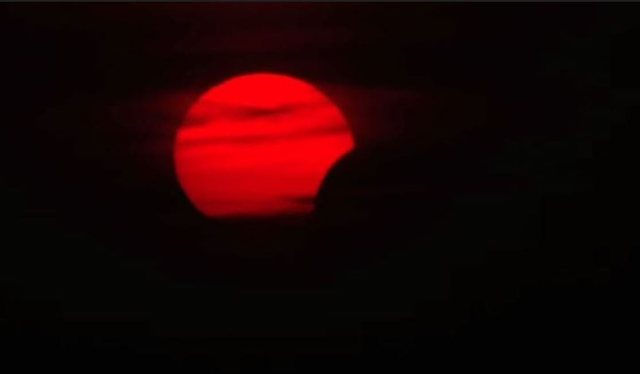
The day will turn into night for more than 6 minutes, the longest solar eclipse of the 21st century is approaching
Daylight will disappear completely for a record duration of 6 minutes and 23 seconds on August 2, 2027, when the Moon will fully block the Sun. This will be the longest total solar eclipse of the 21st century, a phenomenon that occurs once in a hundred years.
This rare astronomical spectacle will be visible from parts of Spain, Morocco, Algeria, Libya, Egypt, and Saudi Arabia. The event is expected to attract millions of astronomers, enthusiasts, and tourists from around the world who want to witness this historic moment.
Scientists explain that the extraordinary length of this eclipse is the result of a rare alignment of the Earth, Moon, and Sun. According to NASA and the Eclipsophile portal, the August 2027 eclipse will last exceptionally long because the Moon will be relatively close to Earth at that time, making it appear larger in the sky.
At the same time, the Earth will be near aphelion—the point in its orbit where it is farthest from the Sun. Because of this distance, the Sun’s disk appears slightly smaller than usual.
This combination allows the Moon to completely cover the Sun for a longer period, extending totality to more than six minutes. Astronomers note that this alignment of celestial bodies is extremely rare.
Egypt at the center of attention
The path of the total eclipse will begin over the Atlantic Ocean before crossing Southern Europe, North Africa, and parts of the Middle East. The entire eclipse will be visible from parts of Spain, Gibraltar, Morocco, Algeria, Tunisia, Libya, Egypt, Sudan, Saudi Arabia, Yemen, and Somalia.
Astronomical calculations show that the point of maximum eclipse duration will be directly over Egypt, making the country a key destination for observers.
During the total eclipse phase, daylight will briefly turn into twilight. Air temperatures will drop noticeably, and planets as well as bright stars will become visible in the sky. This is the only phase during which the Sun’s corona—the outer atmosphere of the star—can be observed with the naked eye.
Observers will also have the opportunity to see rare optical phenomena such as Baily’s beads and the “diamond ring effect,” which occur when sunlight passes through valleys on the Moon’s surface just before and after a total eclipse, as reported by Euronews.al.
Experts remind that for safe viewing, certified eclipse glasses are required during all phases except for the brief minutes of total darkness.
"KORÇA BOOM"