


Doctors have left / Is Albania ready to face new pandemic threats?
- Jun 6
- 9 min read
Although the experience of COVID-19 led to significant investments in hospital logistics and the National Emergency Service, geographic inequality and chronic underfunding remain serious obstacles to dealing with new pandemics on the scale of COVID-19. A critical shortage of doctors, driven by emigration, as well as laboratory dependence on imports, risk causing delayed responses in crises. Experts are calling for the creation of emergency reserves and the strengthening of regional hospital hubs.
The world we live in today has made the spread of infectious diseases from one continent to another faster than ever before. Free movement has increased travel, while modern transport has facilitated mobility for both people and viruses.
It has been six years since the COVID-19 pandemic paralyzed the world in 2020, while the still-fresh trauma has recently been fueled by outbreaks such as Hantavirus and Ebola. Infectious diseases now emerging in Africa and Asia are more alarming than before, but is Albania ready to face another pandemic of COVID-19 scale without experiencing the 2020 tragedy?
Health experts and doctors say the system is certainly more tested and better coordinated than in 2020, but challenges remain, particularly regarding infrastructure in primary healthcare and human resources across the entire health system chain.
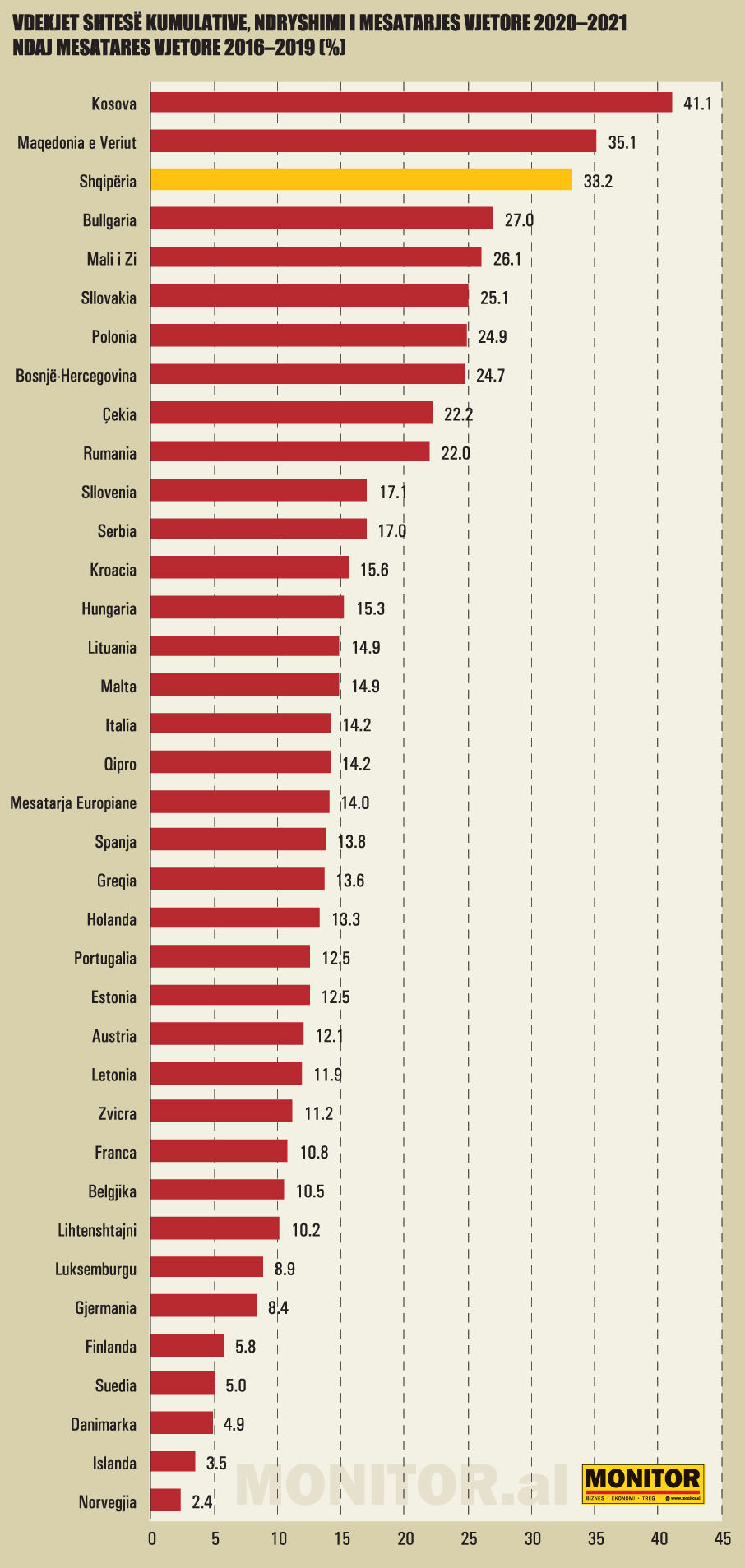
Albania ranked fourth in the world for excess death rates from COVID-19 relative to population, after Azerbaijan, Bosnia and Herzegovina, and Bulgaria, according to data from “Health Data,” a U.S. health assessment institute.
According to the report, Albania had a total of 529 deaths per 100,000 inhabitants during the period from March 2020 to May 2021, ranking fourth among 20 countries with the highest excess COVID-19 mortality rates.
Plan 2030, how healthcare capacities are being strengthened for pandemics
The public health system in Albania has made significant progress, where the consolidation of the National Emergency Service and the full digitization of surveillance systems for infectious agents represent two of its strongest points, said Alban Ylli, an expert in public health policies.
Mr. Ylli said that in this decade, health policy attention is focused on several key directions. First, the expansion of laboratory capacities will gain new momentum next year with the launch of the new National Reference Center.
Second, priority is being given to the training of experts, doctors, epidemiologists, nurses, and support staff, to ensure epidemiological investigation and risk communication during health crises.
He said that the Ministry of Health is working on a capillary system through the “Solidar” program. “We have started work on preparing primary healthcare structures with intersectoral plans and mechanisms to respond in a timely manner during emergencies.
All this architecture will function as a single body, integrating and standardizing the exchange of clinical, laboratory, and environmental data across all our digital platforms,” he said.

How prepared is Albania?
If a new pandemic were to strike today, Albania would not be caught by surprise as it was in March 2020, since emergency response mechanisms have already been created and tested.
However, the long-term resilience of the system will largely depend on the speed of virus transmission and on the ability to retain and motivate existing medical staff, said pulmonologist Luan Dyrmishi, who worked on the front line during the COVID-19 pandemic.
The experience of COVID-19 served as a precedent for the Albanian health system, forcing it to build almost from scratch a logistical and managerial structure for major emergencies.
If another crisis were to occur, Albania would rely on several assets and concrete experiences developed during that period. Operationally, this would be easier, but the country still needs further investments in capacity and logistics, including doctors, hospital infrastructure, and surveillance systems, said Dr. Dyrmishi.
The shortage of medical staff in Albania is a major problem for ensuring dignified healthcare services in normal times, but in the event of a pandemic it becomes a serious threat to saving lives, said Gazment Koduzi, a doctor and experienced health policy expert.
According to World Bank data, during the pandemic period Albania had 1.9 doctors per 1,000 inhabitants, while the European Union average is over 3.5 doctors per 1,000 inhabitants.
The World Health Organization sets the minimum threshold of healthcare workforce at around 2.3–2.5 doctors per 1,000 inhabitants for the basic functioning of a health system in normal conditions, but this level is not sufficient for a pandemic.
The COVID-19 experience showed that countries that managed hospital pressure better generally had a higher doctor density, often above 3.5 to 5 doctors per 1,000 inhabitants, along with a higher number of nurses and strong intensive care capacity.
These countries did not avoid the pandemic, but they managed to prevent system collapse. Our country continues to suffer from high physician emigration, while services are centralized in Tirana and there are significant shortages in the regions.
“For two consecutive years, during the 2020–2021 pandemic, it was worse than a war front. It was exhaustion, with only two or three hours of sleep. While we were working in COVID hospitals at super-intensive levels, hundreds of messages, X-rays, and scans were coming to our phones.
Many patients recovering at home were seeking advice. It was simply impossible to respond to everyone,” said P. Malaj, a pulmonologist who was on the front line during the pandemic.
Mr. Koduzi also states that doctors are still overburdened today. With population aging and the spread of non-communicable diseases, the workload continues to increase, while nearly half of the country’s medical graduates have emigrated abroad.

Laboratory and diagnostic capacities
Public health infrastructure for prevention and early case detection (testing) is another weakness that the healthcare system needs to improve, said Mr. Koduzi.
The COVID-19 pandemic clearly showed the importance of rapid and widespread testing, as well as Albania’s structural limitations in this area. According to data from the Institute of Public Health, testing capacity increased significantly during 2020–2021, but remained mainly concentrated in Tirana.
An analysis by the World Bank on Western Balkan countries highlights that laboratory systems in the region are fragmented and highly dependent on imported reagents.
This dependency became evident when global supply chains were disrupted, causing delays in testing. In Albania, the transport of samples from rural areas to laboratory centers created significant delays, reducing the effectiveness of contact tracing.
In a new pandemic, this means the system risks responding too late, allowing the virus to spread before it is systematically identified, said expert Koduzi, according to whom diagnostics remains a link that still does not ensure the necessary speed and coverage with current capacities.
Weak and uneven infrastructure
Hospital infrastructure in Albania is characterized by a strong concentration in the capital and a lack of medical equipment meeting WHO standards. Most specialized services are provided in Tirana, particularly at QSUT. Meanwhile, regional hospitals have fewer intensive care capacities and less advanced equipment.
Mr. Koduzi said that inefficient distribution of resources is one of the main challenges of Albania’s healthcare system, and the lack of medical equipment remains a major problem even in normal times.
Data from last year showed that the “Mother Teresa” University Hospital Center handled nearly half of the country’s total hospital service flow.
During COVID-19, this was reflected in the high pressure on hospitals in Tirana. In a new pandemic, the lack of flexible isolation and treatment structures could lead to in-hospital transmission and a decline in service quality.
Currently, major hospitals are equipped with imaging technology such as CT scanners, MRI machines, digital X-ray systems, and next-generation ultrasound devices, but the country still does not have a PET scanner in the public system. However, the system’s challenges are related to the management and maintenance of this equipment.
According to audit reports from the Supreme State Audit Institution, one of the main issues is the heavy concentration of high technology in Tirana, which creates geographical inequality and forces patients from various regions to travel to the capital for specialized examinations.
This situation is further aggravated by the lack of regular and fast service contracts. Equipment often remains out of service for months due to delays in securing spare parts, forcing citizens to turn to the private sector and increasing their out-of-pocket expenses.

Underfunded healthcare
Healthcare financing in Albania remains among the lowest in Europe, said Mr. Koduzi, who described it as the main source of problems in the Albanian healthcare system. Data from INSTAT shows that health expenditure is around 3% of GDP, while the EU average is above 8%.
Likewise, per capita spending is several times lower than in European countries. This level of funding does not allow the creation of reserve capacities, which are vital in emergencies.
The system mainly functions to cover basic needs, with no room for major investments in modernization and expansion. In a pandemic, this lack of financial flexibility becomes a serious obstacle, as demand for resources increases sharply in a very short time. Underfunding, in this sense, is the problem that feeds all others, making the system less resilient to major shocks.
Mr. Koduzi said that due to limited funding, low salaries, and less competitive working conditions encourage the departure of doctors and nurses, creating chronic staff shortages and increasing the workload on those who remain.
Another direct consequence of insufficient funding is the degradation of medical infrastructure and technology. If demand suddenly increases, hospitals become quickly overloaded, intensive care beds become insufficient, and staff are forced to work beyond their capacity.
Under these conditions, even diseases that would normally be manageable become more dangerous due to treatment delays and lack of resources.
Gaps in data and information
During discussions with Dr. Dyrmishi on pandemic management and the challenges of the healthcare system, it was highlighted that one of the main difficulties during such periods has been the lack of doctors’ experience in dealing with cases of such complexity, as well as the frequent changes in information regarding treatment methods.
A key issue has been the lack of a unified and official treatment protocol according to disease stages.
Instead of clear and standardized guidelines, situations have often been managed in a decentralized manner, relying on individual decision-making by doctors and the overall experience of the healthcare system, which is considered insufficient for a crisis of this magnitude, said the doctor.
Furthermore, patient treatment has been carried out at all levels of the healthcare system without a clear division according to disease severity, directly affecting treatment effectiveness and clinical outcomes. This uniform approach, without differentiation of cases based on severity, is considered one of the factors that influenced patient outcomes and survival during the crisis period.
Expert Koduzi said that information is fragmented and not always accessible in real time for decision-making. In a pandemic, this limits the ability to track spread and take rapid measures.
Moreover, the lack of predictive analysis makes the system more reactive than proactive. In a health crisis, data and protocols are the basis of every decision, and any gap in this area translates into delayed and less efficient response.
What needs to be prepared
Doctors stated that, according to the analysis, during the pandemic many Albanian families faced high costs for home treatment, spending on private tests and expensive medicines. This situation contributed to their financial strain and to the overload of hospitals.
Dr. Malaj proposes the creation of an “Emergency Pharmaceutical Package” with immediate reimbursement of medicines, stricter protocols to avoid prescription abuse, and free basic laboratory tests in public laboratories.
Expert Koduzi recommends strengthening regional health hubs in Shkodër, Fier, Vlorë, Elbasan, and Korçë, with full intensive care capacity and specialized wards. He also suggests the development of telemedicine for real-time consultations between regional hospitals and specialists in Tirana.
He said that the COVID-19 pandemic revealed the lack of a national stockpile of medical supplies, making Albania dependent on imports and donations. He said that special biosafety warehouses should be created with protective equipment, medicines, and testing kits, along with a rotation system to avoid expiration.
Experts say that preparation for future pandemics cannot be done during a crisis, but through long-term reforms in times of stability, requiring political will and a deep restructuring of the health system.
The COVID-19 pandemic, in addition to being a global health crisis, was a real stress test for every public system. In Albania, it exposed old gaps but also led to the creation of new mechanisms that permanently changed the way emergencies are managed.
One of the strongest lessons of the pandemic relates to hospital infrastructure. Before 2020, Albania had only about 4–5 intensive care beds per 100,000 inhabitants, among the lowest in Europe. This limitation became one of the most dangerous weaknesses of the system during the early waves of the virus.
Through investments in COVID hospitals and the regional network, the number of intensive care beds expanded by over 300%, creating a reserve that previously did not exist.
From around 60–70 functional ventilators at the start of the crisis, the country reached hundreds within two years, distributed across regional hospitals. For the first time, cities outside Tirana became actively involved in treating critical cases.
Hospitals that previously relied on mobile oxygen cylinders were equipped with central pipelines and liquid oxygen systems in more than 15 public institutions. This reduced logistical dependence and increased safety in treating severe patients.
Tracking systems were also upgraded, and today’s generation of doctors has strong experience in responding to similar crises.
“KORÇA BOOM”


