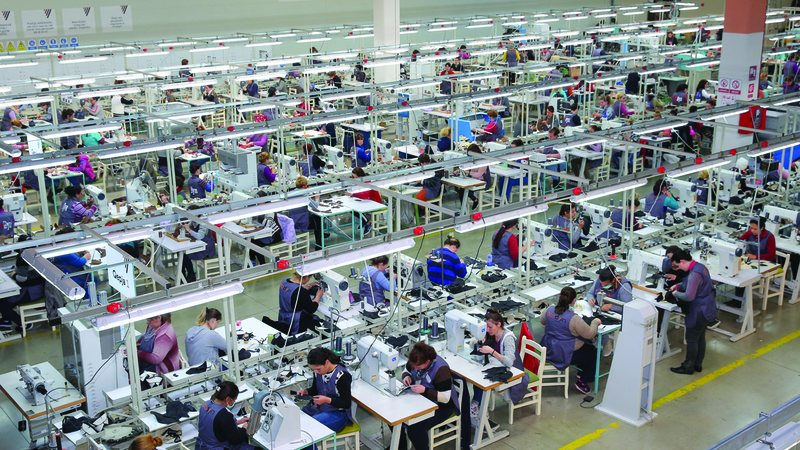
Euro “is crushing” the garment industry, exports fall by 14% in May, factories are closing, leaving workers unemployed
- 3 hours ago
- 4 min read
After a strong increase in April (16.9%), exports slowed significantly in May, growing by only 2.8%, according to INSTAT data.
The sector with the worst performance in May was textiles and footwear, which operates under the “cut-make-trim” (CM) system, recording a double-digit contraction of 14.2%, the sharpest decline of the year. Meanwhile, the most positive performance came from construction materials, machinery and equipment, and food products.
According to INSTAT, in May 2026, goods exports reached a value of 32.7 billion ALL, increasing by 2.8% compared to the same period last year, but decreasing by 6.3% compared to April 2026.
During May 2026, the export growth of 2.8% was positively influenced by the groups: “Food, beverages, tobacco” with +3.3 percentage points, “Construction materials and metals” with +2.2 percentage points, and “Machinery, equipment and spare parts” with +1.1 percentage points. Negative impacts came from “Textiles and footwear” with -4.3 percentage points, “Wood and paper products” with -0.3 percentage points, among others.
Over the five-month period, the trend remained positive. According to INSTAT, for January–May 2026, exports reached 158 billion ALL, with annual growth of 4.5% (down from 4.9% recorded in April). For the five-month period as well, the main positive contributions came from minerals, fuels and energy, construction materials, and machinery and spare parts, while the main negative impact came from textiles and footwear and food products.
The “cut-make-trim” (fason) sector is being “shaken” by the euro.
Exports from the clothing and footwear industry have recorded months of continuous decline. In May, the drop deepened, with exports falling by 14.2%. For the entire five-month period, exports stood at 42 billion ALL, with a contraction of 7.3% (-3.3 billion ALL), the sharpest decline among all groups.
According to exporters, the main reason is linked to the depreciation of the euro. The common currency fell to its lowest historical level in May, reaching around 95 ALL, and later in June it dropped below this level.
The second reason, according to Florjan Zekja from the Pro Export Association, is the war, which has made importing raw materials more difficult and increased costs. Demand from Europe is also declining. Given the lack of prospects, Zekja said many factories are closing and seeking alternative business opportunities. He claims that a Bank of Albania study found that 16,500 workers have left the sector, but the real number is believed to be higher.
Zekja adds that due to rising costs in Albania, many brands such as Cotonella and COFRA are relocating to countries with more favorable economic conditions, such as Tunisia, Morocco, Uzbekistan, Egypt, and others.
Textiles and footwear remain the largest export group in the country, accounting for 26.7% of total exports.
Energy and fuel exports rise
The “Minerals, fuels, energy” group exported 5.7 billion ALL in May 2026, with a year-on-year increase of 5.9%, following a strong 54% surge in April driven by favorable global commodity prices.
Food, beverages, and tobacco return to strong growth
“Food, beverages, and tobacco,” one of the best-performing groups in recent years and one of the two sectors that grew in 2025, improved in May, increasing exports by 17.5%. Over the five-month period, the group expanded by 2.1%.
Construction materials and metals “grow”
“Construction materials and metals” ended 2025 with a 25.4% decline, the sharpest among all product groups. However, in March–May, the group returned to growth, expanding by 16% in May. For the five-month period, exports increased by 12%.
Automotive-supporting industry shows the strongest performance this year
“Machinery, equipment, and spare parts” is the group with the best performance in the first four months of the year. For January–May, its sales reached 18.3 billion ALL, with an increase of 11.2%.
This group, where the automotive industry holds the largest share, began recovering at the end of last year when companies reported rising orders. Some firms produce simple parts for machinery and large transport vehicles, a segment that has shown stable performance.
Meanwhile, the European Commission’s decision to allow internal combustion engine vehicles beyond 2035 in hybrid form has changed the outlook for this year as well, with orders expected to increase. The main pressures faced by this industry in Albania relate to labor force shortages, the continuous depreciation of the euro—since contracts are fixed for several years—and the sudden increase in the minimum wage to 50,000 ALL.
Trade deficit increases
In May 2026, goods exports reached 32.7 billion ALL, increasing by 2.8% compared to the same period a year earlier, but decreasing by 6.3% compared to April 2026.
Imports reached 80.9 billion ALL, increasing by 4.1% compared to a year earlier and by 2.4% compared to April 2026. The trade deficit for this month stood at 48.2 billion ALL, up 5.1% compared to a year earlier and 9.3% compared to April 2026.
Trade performance by partner countries
In May 2026, the countries with the highest export growth compared to May 2025 were Kosovo (3.9%), Greece (5.2%), etc.
Meanwhile, the countries with the largest export declines were Italy (7.9%), Germany (0.6%), etc.
On the import side, the largest increases compared to May 2025 came from Italy (12.2%), China (29.2%), etc., while the largest declines came from Germany (11.3%), Spain (18.8%), etc.
Trade with European Union countries accounts for 56.5% of total trade. In May 2026, exports to EU countries accounted for 66.1% of total exports, while imports from EU countries accounted for 52.6% of total imports.
“KORÇA BOOM”